
ICMR's serological survey, whose findings will be made public next week, suggests that the rate of contagion may be a lot higher in most-affected cities such as Delhi, Mumbai, and Pune.

Nearly half of all coronavirus patients in the country have been cured, taking the recovery rate to over 48 per cent.

'I'm not surprised with what's happening in India,' 'Tiger' Tyagarajan tells Nivedita Mookerji.

'We don't know how complicated things will get with the onset of the monsoon.'

'It's the brazen corruption involving politicians that makes you sit up years after the event,' notes Nivedita Mookerji after reading B K Syngal's Telecom Man.

Most feel as the movement of people normalises, the in-patient volumes in hospitals will grow and by the end of May, occupancy should be around 50 per cent, and 75 per cent over a period of time.

There has been an exponential increase in the use of technology to validate financial numbers, with a greater reliance on electronic evidence, use of live videos where possible, data analytics, and project management software to overcome the physical limitations in verifying transactions and accounts.

A letter sent out by Delhi government asked all medical directors to provide a written explanation on how the health workers contracted the disease despite wearing protective gear, maintaining safe distancing and taking all precautions.

These are becoming one of the most in-demand commodities in the COVID world with malls, offices, banks, and shops lining up to install the structure at their entrances. The company swamped with these orders is a relatively new one, Chennai-based Nanolife, which has patented its Rajat Bhasma formula or the silver nanoparticles solution as a healthy disinfectant. Sceptics, however, say if a person is potentially exposed to the COVID-19 virus, spraying the external part of the body would not kill the microbe, which is inside the body.
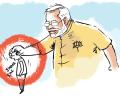
Govt has decided to suspend Sections 7, 9, and 10, which are used to trigger insolvency proceedings for six months or a period not exceeding one year from the date they commence.

'Call it by whichever name, but there is transmission happening between people.'
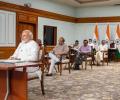
Nivedita Mookerji goes in search of the elusive war room to track and respond to the coronavirus threat.
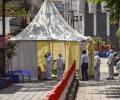
Inside the narrow alleys of the basti, two CRPF companies -- around 150 armed guards -- have been deployed to keep a check on any unnecessary movement, reports Ruchika Chitravanshi.

A single format and simpler, uniform rules would have kept the service going. In other parts of the world including in the US, managing demand and capacities along with ensuring preventive measures were an issue, but there was hardly any administrative hurdle anywhere.

410 civil servants in a feedback survey to the Prime Minister's Office said that the curfew should stay till the pandemic is controlled and asked to increase fiscal spending on health infrastructure to around Rs 5-10 trillion.

In the last one week several companies have had to face the hurdle of making a distinction between what's essential and what's not. To help them the government has now clarified that grocery would include hygiene products such as hand wash, soaps, disinfectants, body wash, shampoo, surface cleaners, detergents, tissue paper, toothpaste, oral care, sanitary pads, diapers, chargers and battery cells, etc.
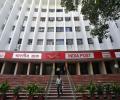
Changing with the times and in compliance with social distancing norms, customers are now picking up their parcels, speed posts and registered letters within the city themselves after they are informed on phone.

The government is drawing up a relief package for industry with steps such as relaxation of asset-classification norms by banks, thus allowing companies to delay the repayment of loans, and tax holidays for the worst-hit sectors like aviation and hospitality. But it might not be enough to stop more bankruptcies from getting filed.

Companies will have to follow all requirements laid out under rules for holding board meetings via video conferencing such as recording of these proceedings, ensuring availability of proper equipment among others.

The government is also planning to set up specialised Benches for competition law to reduce the burden of the appellate tribunal, which is referred to on all matters from company law and IBC to competition law and the national financial reporting authority.
 © 2025 Rediff.com - Investor Information - Advertise with us - Disclaimer - Privacy Policy - Sitemap - Feedback - About us - Terms of use - Grievances